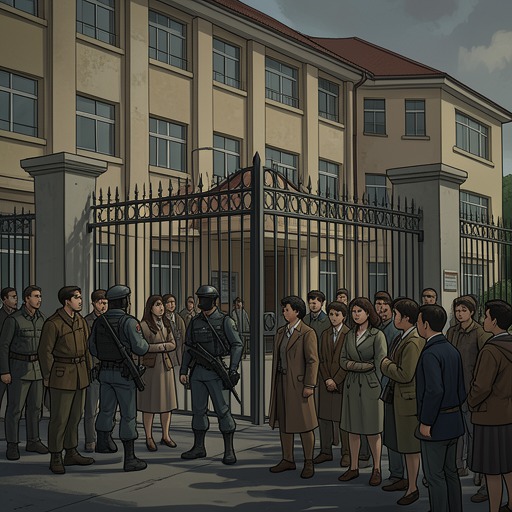
Long and Tate restrain Brianna at Midtown
On the Come UpLong and Tate restrain Brianna Jackson at Midtown after she walks through a metal detector without setting it off. What begins as an unexplained demand for another search becomes a public exercise of school authority, followed by a suspension and a stigmatizing video caption that recasts Brianna as a drug dealer. The incident gives the novel a concrete point of departure for examining how suspicion, discipline, and media framing converge around a Black teenage girl in a school that presents its security procedures as routine.
Causes and Background
The scene begins at the Midtown entrance, where students pass through a metal detector. Curtis goes through without difficulty, followed by Shana, Deon, three sophomores, and Zane. Sonny and then Malik also pass; Brianna follows Malik. The detector does not beep, but Long puts an arm in her way and orders her to go back. Tate’s explanation is simply that Long said so. The sequence makes the difference in treatment visible before anyone gives a reason for it: other students have passed, the machine has registered no alarm, and Brianna is singled out anyway.
After Brianna goes through again, still without a beep, Long orders her to hand over her backpack. She is carrying candy she sells at school, a banned activity that could bring suspension and, given her history of suspensions for other incidents, might risk expulsion. That circumstance explains her fear of the search without establishing that the guards have identified the candy in advance. The conflict turns on a demand backed by institutional authority, while Brianna understands that the bag may expose her to further punishment.
What Happens
When Long reaches for Brianna’s backpack strap, she snatches it away. He grabs her arm and demands the bag; she tells him to keep his hands off her. Long then takes hold of her arms and pulls them behind her as she tries to pull away. He brings her to the floor while Tate removes the backpack. Sonny shouts in protest, and Malik points a camera at the scene and calls for Long to get off her. The presence of classmates makes the restraint both an encounter between Brianna and the guards and an event witnessed and recorded by others.
Long wraps plastic around Brianna’s wrists and accuses her of bringing something into the school. He calls her a hoodlum and refers to how outspoken she had been the previous day. Brianna cannot respond. Her later recollection distinguishes the guards’ act from an ordinary search: the school administrator acknowledges that they used excessive force and put Brianna on the floor, while Brianna corrects that account by insisting that they threw her down. That disagreement over a verb matters because it shows her pressing for an account that does not soften what happened.
Discipline and Public Framing
At the meeting with Brianna’s mother, Jayda Jackson, Dr. Rhodes admits that the guards used excessive force and says the incident will be investigated, with disciplinary action possible if the administration deems it appropriate. In the same conversation, she raises the possibility of disciplinary action against Brianna and asks whether she has been selling candy on campus. The official response therefore recognizes the guards’ conduct while also turning attention toward Brianna’s rule violation. Dr. Rhodes later applies school policy: Brianna receives a three-day suspension for selling banned items on school property without permission.
When Brianna and Jay leave the meeting, the passing bell has just rung. Students pour into the hall, and Brianna notices glances, stares, and whispers. She has become visible to her classmates, but in a way she does not welcome. On the ride home she is quiet. She turns the word hoodlum over in her mind, listing its associated labels and recognizing that Long has made the word apply to her. Her brief verse rejects the implication that nothing good can come from her neighborhood, ending in refusal rather than accepting the label as a definition of herself.
The recording also circulates beyond the immediate school encounter. Someone uploads a video of Long and Tate pinning Brianna to the ground, but it leaves out the moments before the restraint, including the guards throwing her down. The uploader labels it as a drug dealer caught at Midtown. In Brianna’s account, the title reduces an incomplete recording to a verdict: it supplies viewers with an identity for her while omitting the sequence that could explain why the confrontation began. The incident thus generates a second, mediated version of events that travels with her beyond the school.
Escalation and Aftermath
The incident continues to shape how the characters interpret Midtown’s security. Jay explains why she will not let Brianna transfer to Garden Heights High: she and Brianna’s father had promised that Brianna and Trey would never attend it, and the school has actual police and is treated like a prison. Jay argues that Brianna has a better chance at Midtown, while warning that she will face many more people like Long and Tate and must not let their actions determine her choices. The conversation places the restraint within a wider contrast between two schools’ security environments, without suggesting that Midtown is free of the forces Jay fears.
Later, students discussing the return of Long and Tate worry that Midtown may adopt the Garden Heights model and station armed police as security. Malik connects that fear to parents who believe the drug-dealer narrative about Brianna, predicting that the guards have reason to see the students as threats. The prediction is framed as a fear and inference, not a confirmed change in school policy. Even so, the sequence shows how the video’s caption can outlast the original event: a label attached to Brianna helps shape expectations about security for the whole student body.
That climate resurfaces during later coverage of the student uprising. News reports describe arrests and say the guards were hospitalized and expected to recover, while students are sent home for the day. The report also presents excerpts from Brianna’s song, linking its lyrics to the unrest. In a later interview, Hype treats some of the lyrics as excessive and focuses on references to weapons and violence against police. Brianna challenges the gendered double standard behind that reaction, asking whether the same material would have surprised him when her father rapped at sixteen; he admits it would not have. These later disputes do not erase the Midtown restraint, but they extend its central question: whose account is accepted when security, a young Black girl’s reputation, and public fear collide.
Narrative Significance
The restraint is not isolated from the novel’s other depictions of punishment. Jay’s warning about Garden Heights High connects school security to a prison-like model; later anxiety about armed police extends that model into Midtown, while Jay’s confrontation with Aunt Pooh in jail brings the consequences of punitive systems into family life. These are distinct developments, but together they place the original scene within a continuum in which students and relatives are readily treated as threats or offenders.
The incident also establishes a recurring tension between the record and the story told about it. The metal detector does not beep; the school acknowledges excessive force; the video excludes the lead-up; its title calls Brianna a drug dealer; and subsequent public discussion attaches her lyrics to school violence. Each version emphasizes different evidence and distributes blame differently. Against those reductions, Brianna’s correction that she was thrown rather than merely put on the floor, and her refusal to accept hoodlum as an identity, preserve her effort to name what happened for herself. The scene’s consequence is therefore both disciplinary and narrative: Brianna loses three days of school, but the label produced by the encounter travels much farther.